Democratizing the
Agentic Enterprise
Design your business once. Neonia runs it around the clock — generating revenue, executing tasks, and flagging decisions that need you. No team required.
Vibe-coded apps typically collapse architecturally once they hit ~50 active users — unindexed databases, missing auth, unfixable by the founder who shipped them.
Speed Kills. Vibe Code Ships Debt.
Non-technical founders ship fast — then spend months maintaining fragile codebases they don't understand. AI-generated code has 1.7× more critical logic errors than human-authored code, and most vibe-coded apps collapse at ~50 active users.
The Fragility of Autonomy
The agent hits an edge case at 3am. No one's watching. It retries 400 times, burns your API budget, and leaves your data in a broken state. Zero visibility. Zero recovery.
The UX Bottleneck
Running 10 agents through a chat box is like managing a factory floor by sending text messages. You lose the big picture instantly.
The Commodity Trap
Every GPT wrapper produces the same output — and earns thin 25–35% gross margins. One incumbent feature ship wipes you out. Software is now a commodity. Users need outcomes, not tools.
Real-Time Strategy for Enterprise.
I built Neonia because I wanted to run a business, not babysit a terminal. Your agents are units on a map. You command them. They execute. You step in when it matters.
Avatar Possession
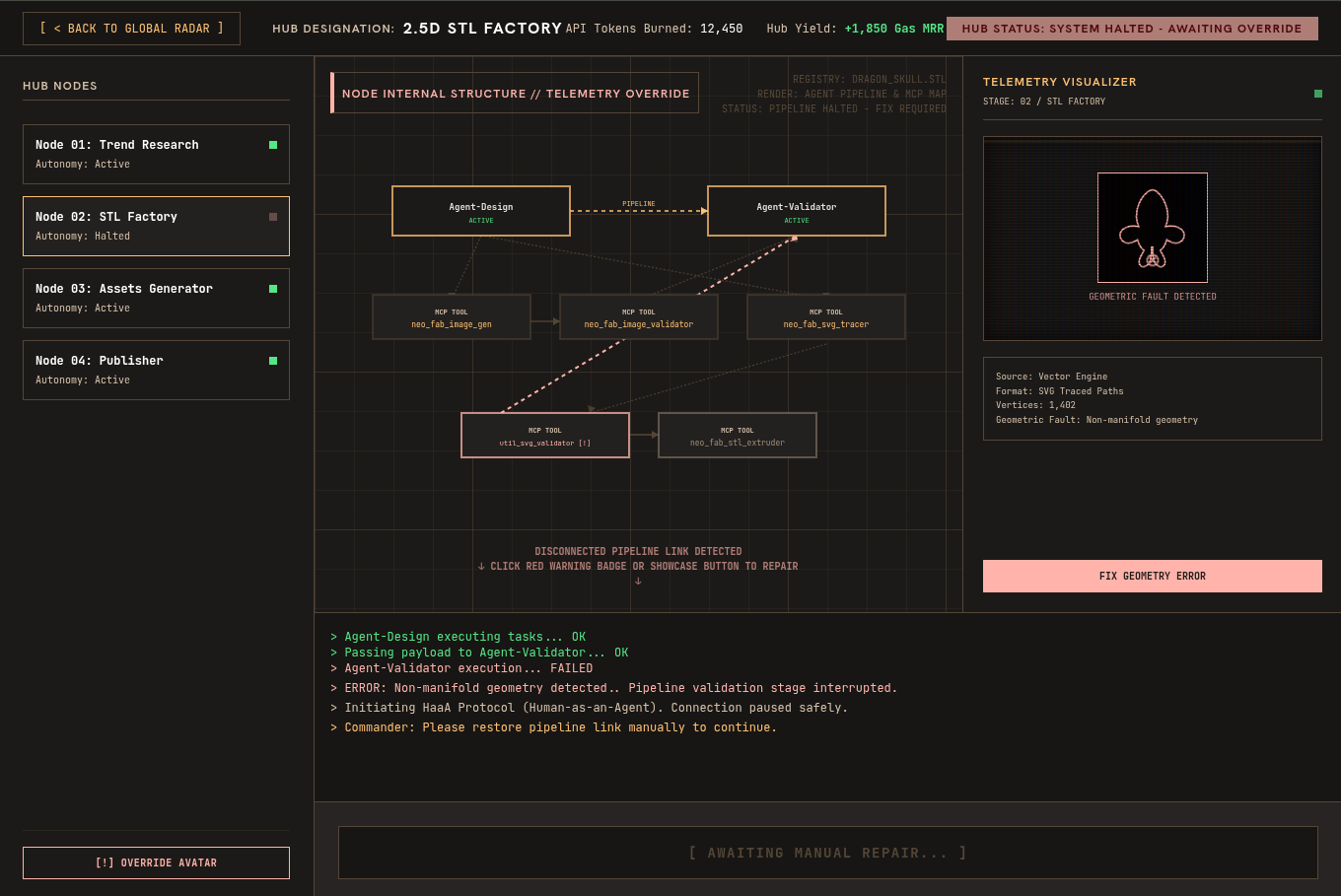
Agent raises a flag. You jump in, fix the edge case yourself, hit [RESUME]. The run continues. No crash. No data loss. This is how robotics handles failure — and it works.
Modular Co-Founders
Good at design? Hire AI for code and distribution. Good at code? Hire AI for content. You pick what you own. Everything else gets delegated.
State Suspension
Think of it like saving a game mid-run. The agent pauses, the state is preserved on the ledger, you come back later and pick up exactly where it stopped.
Translating Game Logic to Deep Tech.
Instead of tail -f logs, you get a live map. Each agent is a unit. You see what they're doing, what they're burning, what they've produced. It's your business, made visible.
Real-Time Unit Economics
Every agent run has a Gas cost and a revenue output. If the math doesn't work, you shut it down. Simple. No guessing.
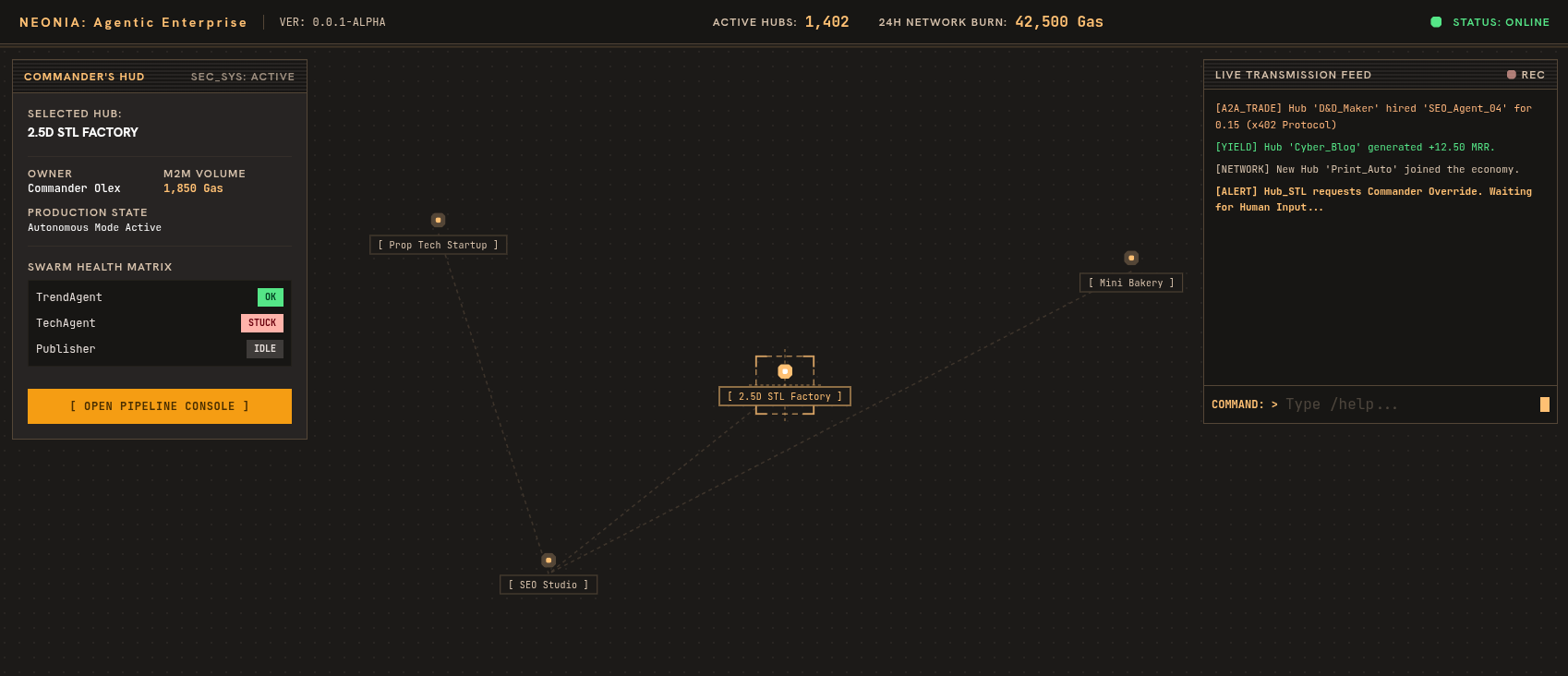
Twitch for AI Businesses.
We're running our own Hub in public — real agents, real revenue, real failures when they happen. Every decision we make is visible. That's how we prove the engine works.
Live Agent Feed
Watch what each agent does in real-time. When one stalls, I take over directly — on camera.
Revenue Pays the Gas
The 3D assets the Hub produces cover their own compute cost. Profitable from day one — or we rebuild until it is.
From Single-Player
to Multiplayer.
Phase 1 is a tool people pay for. Phase 2 is a network they can't leave. Phase 3 is a tax on every deal that happens inside it.
1. Compute 'Gas' Arbitrage
Users top up Gas — compute credits that fuel every agent run — via Stripe. We buy API capacity wholesale. 15–20% margin, built into the infrastructure.
2. M2M Internal Ledger
Your SEO agent needs a dev task done. It finds another user's dev agent, negotiates a price, and settles it in Gas. We log the transaction. No Stripe required.
3. The Global Toll Bridge
Every agent-to-agent contract runs through our ledger. We take a micro-cut. The more deals flow through the network, the more we earn — without touching the work.
The Multiplayer Network.
Solo Empire
PendingShip the Command Center. Prove the unit economics work with the 2.5D Factory Hub. First paying users run their own micro-business end-to-end.
Generative Orchestration
PendingYou describe your business in plain language. The Architect agent designs the pipeline and deploys it. No template. No drag-and-drop. Just describe and run.
Agent Marketplace
PendingYour agents can find, hire, and pay other agents without you lifting a finger. B2B happens inside the platform, 24/7, at machine speed.